





Index In Real Money/Gold
June 25, 2024 - We have a crash and a solid downtrend for ALL stock markets expressed in Fiat Gold Money!
|
The charts below tell us that the Gold and silver sector will perform BETTER than the traditional Stock markets!
|
Dow lost 40% in gold in 2009 and 80% since 2001! "What sense does it make to accumulate Fiat Money (Treasuries & bank deposits) which are slowly but surely becoming worthless..." |
|

Charts (except India) all look similar and are extremely Bearish.
These PF charts answer an essential question and show what REALITY looks like!The best way to measure the Dow in real terms is against gold. Gold is the only money that has survived in the last 5,000 years; gold represents stable purchasing power. Over time, gold doesn’t go up. Instead, paper or fiat money goes down until it reaches zero. Green colored charts = Bull trends, Red = bear trends, White = sideward & we don't know yet! |
||||
| German DAX | Spanish Ibex | French CAC | Footsie Gold |
Japan Nikkei |
 |
 |
 |
 |
 |
| Downtrend |
Downtrend | Downtrend | Downtrend | Downtrend |
| Greek drama | Swiss index | Belgium Dow |
Dutch AEX | South Africa |
 |
 |
 |
 |
 |
| Downtrend | Downtrend | Downtrend | Downtrend | Downtrend |
| India Sensex | China -80% | USA- Dow Jones | Bank Index | |
 |
 |
 |
 |
 |
| Downtrend | Downtrend | Downtrend | Downtrend | |
| Nasdaq in Gold | SP500 in Gold | Majors in Gold | Juniors in Gold | Bitcoin in Gold |
 |
 |
 |
 |
 |
| Downtrend | Downtrend | Downtrend | Bottom? | |
| AEX | BEDOW | DAX | Bonds in Gold | Real Estate in Gold |
 |
 |
 |
 |
 |
| downtrend | downtrend | downtrend | Downtrend | For all the wisenoses still pretending Real Estate is a GOOD investment!! |
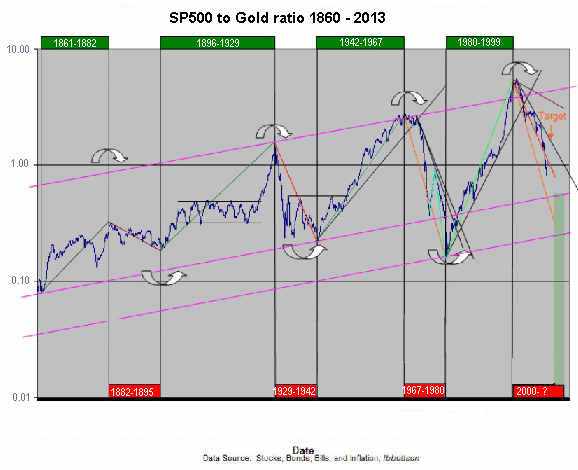
One of the best ways to gain some perspective on stock markets and gold is to look at the Dow Jones Industrials (DJI)/Gold ratio. The Dow/Gold ratio has a long history, as the 200-year chart above attests. The ratio had had a considerable movement over the years, which is an accomplishment since gold was, until August 1971, fixed roughly at $20.67 and then at $35 in April 1933, when the Roosevelt administration revalued gold to devalue the US.
The devaluation of the US dollar was a part of the currency wars of the 1930s. The Roosevelt administration also forbade the hoarding of gold, gold bullion, and gold certificates, and the US administration purchased gold at the then-fixed rate of $20.67. The resulting profit was used to fund the Exchange Stabilization Fund (ESF), established by the Gold Reserve Act of 1934. One thing that stands out in the above chart is that following the creation of the Fed in 1913, the Dow/Gold ratio has become much more volatile.

When the Dow/Gold ratio reaches 1:1, this means a loss of more than 90% in real terms for stock market investors – $ 1 million in stocks would be worth less than $100,000 in today’s money. And remember that the last time a 90% fall happened in the Dow was in 1929-32. It took 25 years to return to the previous peak.
A different story: Stock market expressed in real money (Gold) since 1861
© - The report's contents may NOT be copied, reproduced, or distributed without the explicit written consent of Goldonomic.